Nigeria Launches “Hire From Nigeria” Campaign For Global Opportunities
by admin on | 2026-09-01 11:36:25
Share: Facebook | Twitter | Whatsapp | Linkedin Visits: 36
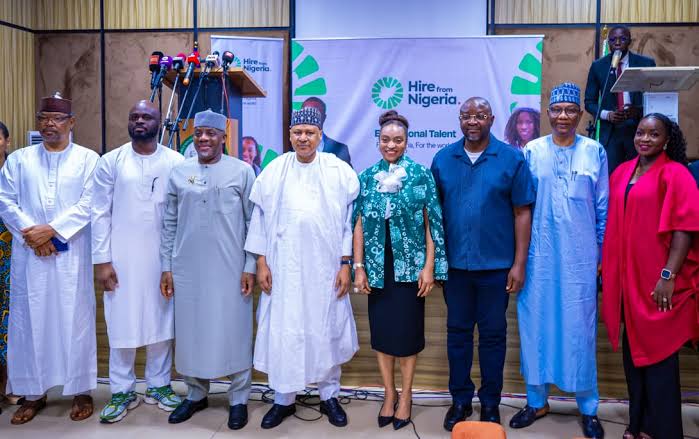
Nigeria Launches “Hire From Nigeria” Campaign For Global Opportunities
By Maryam Muhammad
The Nigerian Government has announced its commitment to transforming the country's substantial pool of skilled youth into a significant source of foreign exchange and global business opportunities through the recently inaugurated “Hire from Nigeria” campaign.
Nigeria's Minister of Information and National Orientation, Mohammed Idris, stated this in Abuja, at the official press conference to unveil the initiative, the "Hire from Nigeria" campaign.
According to the Information Minister, Nigeria’s human capital had become one of the country’s most valuable economic assets.
Idris noted that the changing nature of the global economy had created an opportunity for Nigeria to export knowledge, skills, creativity and professional services without requiring Nigerians to physically relocate abroad.
“For decades, discussions about exports have focused largely on the products that leave our shores: oil, agricultural produce, solid minerals and manufactured goods. But the global economy has changed,” he said.
Idris explained that the “Hire from Nigeria” campaign was designed to position the country as a preferred global source of skilled talent and digitally delivered services.
He stressed that Nigeria has the demographic strength, entrepreneurial culture, English-language proficiency and growing technology and professional services sectors required to compete in the global services market.
"Possessing skilled workers alone was insufficient. Nigeria must also make its talent visible and credible to international employers. Having talent is not enough. The world must know that the talent exists, and must have confidence in the quality of our professionals and businesses,” Idris said.
The minister reiterated the Federal Ministry of Information and National Orientation's commitment to using its communication platforms, agencies and partnerships to promote Nigerian talent and improve the country’s image as a destination for global business and services.
"This campaign will be taken to the international community during the 81st Session of the United Nations General Assembly, where Nigeria would seek to showcase its talent and attract global employers,” he said.
Idris also added that the initiative would provide opportunities for Nigerians to participate in the global economy without necessarily leaving the country.
“A young Nigerian does not have to leave the country to participate in the global economy. With the right skills, infrastructure, professional standards, and access to markets, Nigerians can live and work and earn here at home, while providing valuable services to clients and employers worldwide.
Such a development would increase foreign exchange inflows and tax revenues while expanding Nigeria’s skills and knowledge base", Idris added.
The Minister of Industry, Trade and Investment, Dr Jumoke Oduwole, said the initiative was part of the Nigerian Government’s broader strategy to convert Nigeria’s demographic advantage into jobs, export earnings and investment.
Oduwole disclosed that the government’s National Talent Export Programme (NATEP) had set an ambition of enabling one million export-linked jobs by 2030. Oduwole said the government was already building the infrastructure required to connect Nigerian talent with international demand.
According to her a digital services survey conducted in partnership with the United Nations Development Programme had mapped Nigerian providers across 17 sectors.
Oduwole noted that, more than 90 per cent of the digital service providers identified were headquartered in Nigeria, while 41 per cent of digital entrepreneurs were under the age of 35.
"Established Nigerian firms are already serving an average of 2.6 international markets. These figures show that Nigeria’s advantage is not theoretical. We already have professionals, a strong services base across relevant sectors, a growing technology ecosystem and a time zone well suited to African and European markets and beyond,” she said.
Oduwole stressed that the government’s task was now to turn that capacity into actual contracts and export earnings by ensuring that Nigerian professionals met international standards and could consistently deliver quality and value.
She also announced that Nigeria’s first national outsourcing policy was expected to be launched in November 2026. Dr Oduwole while describing “Hire from Nigeria” as more than a communications exercise, said the initiative was a national economic proposition.
“Hiring from Nigeria is not an act of goodwill. It is a sound commercial decision that delivers capability, innovation, competitiveness and value,” Oduwole said.
Also speaking, the Minister of Education, Dr Maruf Tunji Alausa, said the success of the initiative would depend largely on the country’s ability to produce industry-ready and globally competitive workers.
Alausa said more than 70 per cent of Nigeria’s estimated 220 million population was below the age of 30, describing the youthful population as both an opportunity and a challenge.
“We have two choices. Either we turn this into a demographic dividend, or it becomes a demographic catastrophe,” he said.
Alausa disclosed that more than 200,000 Nigerians were being trained across over 1,200 technical and vocational education centres, with the government shifting emphasis from theoretical learning to practical skills.
"The initiative would help Nigeria capture a greater share of the expanding global services market while creating employment, generating foreign exchange and enabling Nigerians to compete internationally from within the country", he said.
Alausa also announced plans to launch a Digital Technology Academy that would train more than 35,000 Nigerians in areas such as software development, cybersecurity, IT automation, artificial intelligence and machine learning, natural language processing, cloud computing and quantum computing.
"This initiative would complement the existing 3 Million Technical Talent programme and prepare Nigerians to work for international companies while remaining in the country. We want Nigerians to be trained, certified and ready for the hire,” he added.
On his part, the founder and President of Tech4Dev, Joel Ogunsonla, said Nigeria had effectively been exporting its talent for decades but had failed to fully capture the economic value generated by its professionals.
“Nigeria has been exporting talent for decades. We simply just never sent an invoice, or never collected,” Ogunsonla said.
He said Nigerian doctors, engineers, technicians, caregivers and creative professionals were already contributing to economies around the world.
Ogunsonla identified discoverability, trust and global access as the three major challenges the campaign was designed to address.
“Our job is to bring the two together, because talent that is not connected to opportunity becomes frustration. Skill without access becomes wasted potential. Ambition without a pathway becomes migration pressure,” he said.
The Tech4Dev founder said the campaign was ultimately about jobs, young people, women, foreign exchange and economic growth.
“This is not a slogan. Nigeria has the talent. The world has the demand. What has been missing is the pathway,” Ogunsonla said.
Ogunsonla urged the media to help change the narrative about Nigerian talent by presenting the country as a serious competitor in the global services market.
As the campaign moves towards its global presentation at the United Nations General Assembly, the government’s message to international employers is clear: Nigeria’s talent is available, competitive and ready for global business.
The “Hire from Nigeria” campaign is being implemented through collaboration among the Federal Ministries of Information and National Orientation; Industry, Trade and Investment; Education; NATEP; Tech4Dev; the Bank of Industry’s iDICE programme and other public- and private-sector partners.
Trending Stories
-
 Reps Summon Six FCT Councils Over N100bn Audit
-
 Tinubu: Nigeria Slashes Reliance on Crude Oil Revenues
-
 Education Minister Pledges 10 Million Votes for Tinubu
-
 Political Reconciliation Gains Ground as Wike, Fubara Camps Meet
-
 INEC Records Over 103 Million Registered Voters Ahead 2027 Elections
-
 Aircraft Accident: NAF Activates Search, Rescue Operation
-
 NGF Mourns Victims of Nigerian Air Force Aircraft Crash
-
 Customs Warns Against Petroleum Smuggling, Vows Relentless Enforcement
Advertisement